
IMPDH2 Community
Supporting those living with an IMPDH2 genetic variant and the families who care for them
Where’s the roadmap when someone you love receives a diagnosis of an extremely rare genetic condition?
How do you think about the future when so much of it is unknown?
Is there even a future to think about?
IMPDH2 related disorders are extremely rare. The first cases of this genetic alteration were discovered less than ten years ago and there is still so much we do not know. There is currently no cure and no genetic treatment that directly addresses the underlying cause.
Together we can help one another understand the different ways IMPDH2-related disorders can present, the therapies families have explored, and the treatments and medications that may be helpful for specific associated conditions. There is something comforting about being in the unknown with someone who understands.
We wish you weren’t scouring the internet for answers, but since you are we are so glad that you found us.
Common Questions After Diagnosis
Is my child going to die?
Fortunately, based on what we currently know, we don’t believe this condition is fatal or degenerative! The oldest known individual with an IMPDH2 genetic variant is in their 40s. Some associated conditions, such as dystonia, may become more noticeable over time. Current research does not suggest that this alteration causes ongoing deterioration of the body's cells or nervous system.
How many people are diagnosed with IMPDH2 related disorders?
An exact number of individuals diagnosed is unknown but we believe it to be fewer than 20. The condition was only discovered a few years ago and requires whole genome sequencing to find. It is not caught during standard genetic testing so likely more cases exist but are either misdiagnosed or undiagnosed.
What does my child’s future look like?
We don’t know exactly what the future will look like. Children with the alteration have a wide range of strengths and challenges - many experience global developmental delays but the long-term outlook exists on a spectrum. Some communicate verbally while others are nonspeaking and communicate in their own unique way. Some eat entirely by mouth, others benefit from a gastrostomy tube (G-tube). Several children are able to move independently, be that crawling, walking, or a combination. Because there are so few cases there is no consensus on what the future looks like. What we do know is that children can continue to learn, grow, and make meaningful progress. Physical therapy, occupational therapy, speech therapy, and other supportive services help children build skills while also helping parents better understand how their child learns and experiences the world.
For more information about additional diagnosis your child may receive you can check out our Associated Conditions page.
About Us
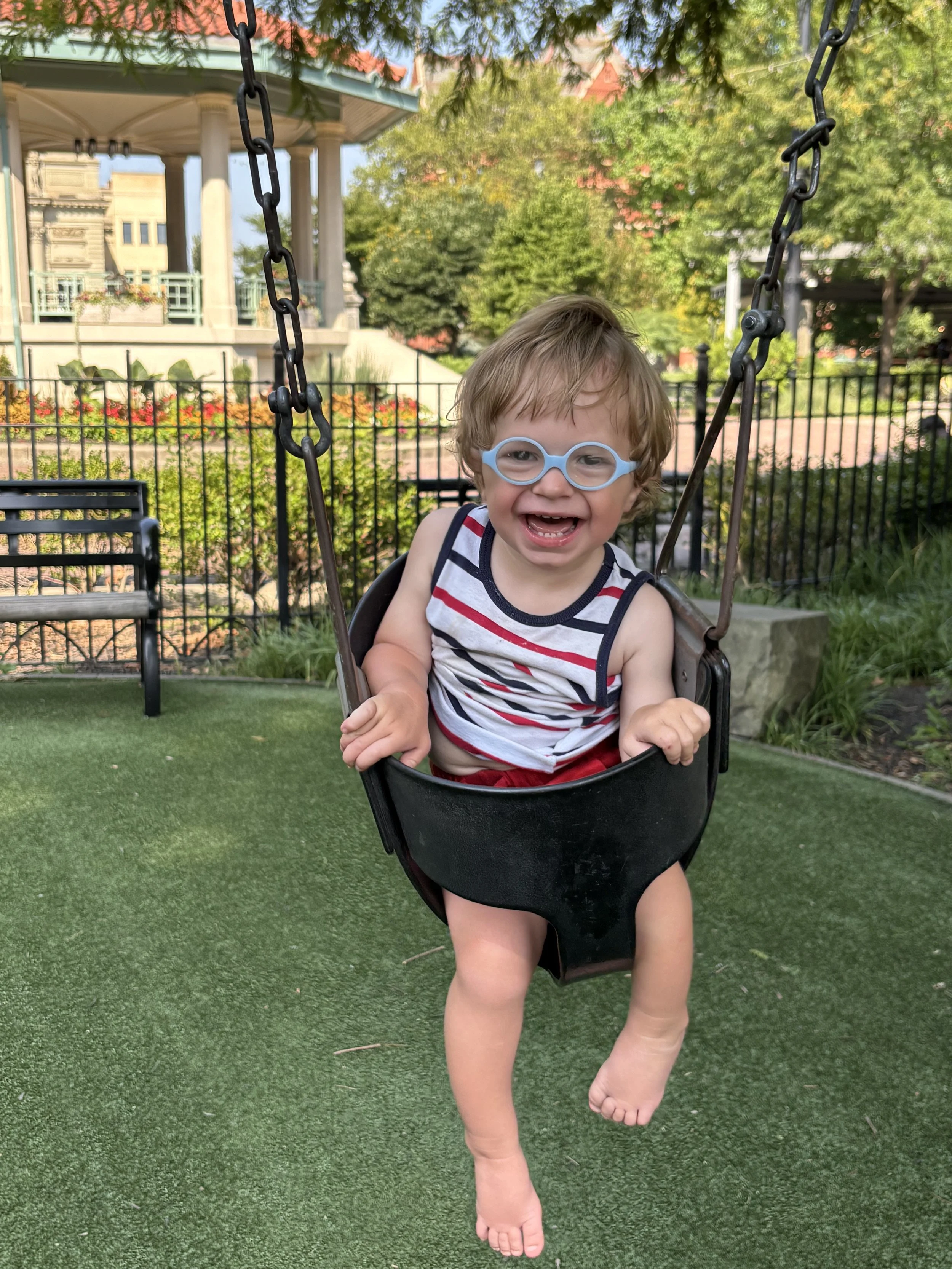
Our world came to a screeching halt in February of 2025 when I woke to my then 7 month old, Sebastian, seizing at 4AM. The day continued with an ambulance ride to Cincinnati Children’s Hospital, more doctors and nurses than I could possibly count, a CT scan, an MRI, and procedures I barely remember. It ended with Sebastian’s unofficial cerebral palsy diagnosis. After months of concerning developmental delays we were starting to get answers. But because my pregnancy, labor, and delivery were uncomplicated we didn’t know what caused his CP. Neurology recommended genetic testing but cautioned there was only about a 35% chance we’d find an answer.
Less than a month later we received the call from Genetics with news we never expected. There was a match. Sebastian has a variant in the IMPDH2 gene. At the time we were told there were six other known cases worldwide. There is no cure, no easy to find information, and no roadmap for treatment. Our only option was to try and manage the other conditions this genetic alteration causes.
We were told that Google would provide almost no information beyond academic research and to ignore anything that mentions cancer (it’s unrelated to this mutation). But luckily I did Google and found Killian’s story. That story allowed me to connect with his wonderful mom, Jenny, and find our IMPDH2 Facebook group.
The rare genetic disease world is challenging and overwhelming. It’s isolating. But there is hope in community. This website was created to make it easier for families affected by IMPDH2-related disorders to connect with one another and to provide a starting point for information that would have helped us during those early months. We were completely new to the medical world and are so grateful for those that helped point us in the right direction. Please join our Facebook group to connect with other families and help us all better understand how IMPDH2-related disorders can affect different people.
We're sorry that you had to search for us. But we’re so glad you found us!
-Mary and Jake, Sebastian’s parents